


Cities with Highest Population Growth: The Absolute Numerical Gainers


The study of demographic expansion in the United States often focuses on percentage growth rates, which naturally highlights smaller suburban enclaves experiencing rapid transformation. However, a parallel and equally critical demographic narrative lies in absolute numerical growth. While a small exurb doubling its population from five thousand to ten thousand represents a hundred percent growth rate, a major metropolitan center adding twenty thousand residents in a single year represents a far larger migration volume. These highvolume destinations, or population growth cities, serve as the primary engines of regional economic development, absorbing massive amounts of domestic and international migration.
Analyzing these absolute numerical gainers reveals the macrolevel patterns of the modern American population shift. The movement of people is not random; it is guided by corporate relocations, industrial expansion, climate preferences, and regional tax policies. As hundreds of thousands of household pack moving trucks annually, their destinations indicate where capital, infrastructure, and housing development are converging. Understanding these absolute numbers is crucial for real estate developers, municipal planners, and commercial business entities looking to align their operations with shifting consumer bases.
To understand how these demographic shifts impact business landscapes, prospective founders can consult a comprehensive startup filing guide to align corporate registrations with emerging municipal tax bases.
|
Region |
Primary States |
Total Numeric Growth |
Lead Drivers |
|
South |
Texas, Florida, North Carolina |
345,000 |
Job creation, lower cost of living, warm climate |
|
West |
Arizona, Nevada, Utah |
112,000 |
Technology sector expansion, coastal state outflows |
|
Midwest |
Ohio, Indiana, Missouri |
45,000 |
Manufacturing resurgence, affordable housing stock |
|
Northeast |
Pennsylvania, New Jersey |
18,000 |
Suburban outerring expansion, localized distribution hubs |
The Geographic Focus of Major Population Inflows
The absolute volume of population growth in America is heavily weighted toward the South and West, with several metropolitan regions capturing a disproportionate share of the total national gain. The Texas Triangle, the Central Florida corridor, the Phoenix metropolitan valley, and the Charlotte metro area are experiencing continuous, highvolume inflows. These regions do not merely attract individual households; they attract entire corporate ecosystems, which in turn fuels further employmentdriven migration.
The concentration of numerical growth in these areas is driven by a feedback loop of economic development. When major employers relocate their headquarters to a city, they bring thousands of highlysalaried jobs. This corporate migration creates immediate demand for residential construction, professional services, retail storefronts, and local infrastructure. The resulting job market attracts job seekers from across the country, creating a steady stream of incoming residents that expands the local consumer base.
For retail and serviceoriented businesses seeking to establish a physical presence in these highvolume corridors, maintaining high digital visibility is essential. Registering your company on a prominent online business listings platform is a highly effective way to capture incoming consumer traffic and establish localized domain authority.
Profiles of the Leading Numerical Population Gainers
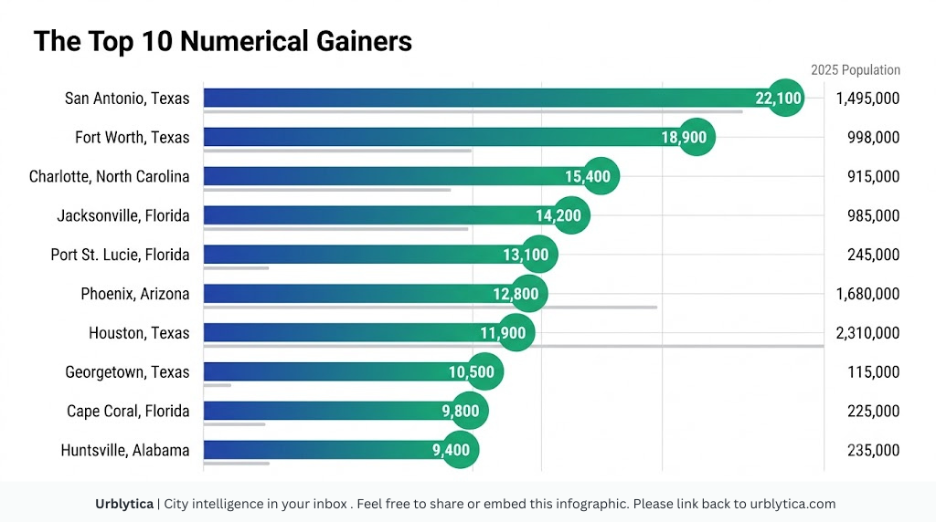
1. San Antonio, Texas
San Antonio leads the nation in absolute annual numerical growth, adding over twentytwo thousand residents in a single calendar year. Unlike other Texas cities that rely heavily on masterplanned exurban sprawl, San Antonio has successfully captured growth within its municipal boundaries. The city's expansion is supported by a highly diversified economy, including massive healthcare networks, military bases, cybersecurity firms, and tourism. The relative affordability of housing in San Antonio compared to Austin and Dallas makes it a primary destination for middleincome families and remote professionals seeking lower living expenses.
2. Fort Worth, Texas
Fort Worth added nearly nineteen thousand residents, cementing its status as one of the fastestgrowing major cities in the United States. While historically overshadowed by neighboring Dallas, Fort Worth has carved out its own distinct economic identity. The city has seen unprecedented residential development in its northern sectors, driven by proximity to the Alliance Texas logistics hub and major corporate offices. Families are drawn to Fort Worth’s high quality of life, robust school districts, and historic cultural institutions.
3. Charlotte, North Carolina
Charlotte added over fifteen thousand residents, continuing its multidecade run as a premier banking and energy hub. As the secondlargest financial center in the United States, Charlotte attracts highly educated young professionals and corporate executives. The city's growth is supported by a comprehensive transit system, thriving urban neighborhoods, and excellent regional university systems. The surrounding suburbs in Mecklenburg County are also experiencing parallel highvolume gains, making the Charlotte metro area a massive demographic anchor.
4. Jacksonville, Florida
Jacksonville gained over fourteen thousand residents, leveraging its massive geographic footprint to capture diverse population inflows. As the largest city by land area in the contiguous United States, Jacksonville has ample room for suburban expansion without the immediate land constraints faced by coastal South Florida. The city's economy is anchored by a major deepwater port, military installations, financial services, and a rapidly expanding medical sector. Jacksonville’s coastal lifestyle and relatively affordable real estate continue to draw retirees and remote workers alike.
5. Port St. Lucie, Florida
Port St. Lucie added over thirteen thousand residents, demonstrating the massive appeal of Florida's Treasure Coast. Positioned midway between Orlando and Miami, Port St. Lucie has become a primary relief valve for South Florida's high housing costs. The city’s growth is driven by masterplanned developments, excellent golf courses, and safe residential neighborhoods. The influx of retirees and remote workers has created a booming local service economy, with healthcare facilities and retail centers expanding rapidly.
|
Rank |
City |
State |
2025 Population |
Annual Numerical Increase |
Key Driver |
|
1 |
San Antonio |
Texas |
1,495,000 |
22,100 |
Affordable housing, healthcare sector |
|
2 |
Fort Worth |
Texas |
998,000 |
18,900 |
Corporate decentralization, logistics |
|
3 |
Charlotte |
North Carolina |
915,000 |
15,400 |
Financial services, energy sector |
|
4 |
Jacksonville |
Florida |
985,000 |
14,200 |
Marine logistics, military expansion |
|
5 |
Port St. Lucie |
Florida |
245,000 |
13,100 |
South Florida costrelief relocation |
|
6 |
Phoenix |
Arizona |
1,680,000 |
12,800 |
Semiconductor manufacturing, solar |
|
7 |
Houston |
Texas |
2,310,000 |
11,900 |
Energy sector, medical research |
|
8 |
Georgetown |
Texas |
115,000 |
10,500 |
Austin tech sector sprawl, retirement |
|
9 |
Cape Coral |
Florida |
225,000 |
9,800 |
Waterfront living, service sector |
|
10 |
Huntsville |
Alabama |
235,000 |
9,400 |
Aerospace technology, federal jobs |
6. Phoenix, Arizona
Phoenix added nearly thirteen thousand residents, driven by massive investments in industrial manufacturing and advanced technology. The city has transitioned from a retirement haven into a major hightech center, with massive semiconductor fabrication plants and renewable energy companies expanding the area. Phoenix's expansive geographic footprint and proximity to California make it a natural destination for businesses and individuals fleeing high coastal costs.
7. Houston, Texas
Houston gained nearly twelve thousand residents, maintaining its position as a global center for energy, healthcare, and aerospace. The city’s absolute growth is supported by its lack of formal zoning laws, which allows developers to build housing quickly in response to market demand. Houston’s massive medical center, the largest in the world, continues to attract highly skilled healthcare professionals, while its diverse industrial base provides a steady stream of workingclass employment opportunities.
8. Georgetown, Texas
Georgetown, located just north of Austin, added over ten thousand residents, making it one of the fastestgrowing midsized cities in the country. Georgetown has successfully captured the northern expansion of the Austin technology sector while maintaining its historic charm and vibrant town square. The city is highly popular with both young techindustry families and affluent retirees, resulting in a balanced demographic profile and strong local tax revenues.
9. Cape Coral, Florida
Cape Coral gained nearly ten thousand residents, leveraging its extensive canal system and waterfront lifestyle to attract inbound migration. Located in Southwest Florida, Cape Coral has experienced rapid poststorm recovery, with new residential construction booming. The city's growth is driven by retirees and families seeking outdoorcentric lifestyles, creating strong demand for local construction, retail, and healthcare services.
10. Huntsville, Alabama
Huntsville added over nine thousand residents, cementing its position as the most populous city in Alabama. Known as Rocket City, Huntsville is a major hub for federal aerospace research, defense contracting, and advanced engineering. The presence of Redstone Arsenal and NASA’s Marshall Space Flight Center provides a highly stable, highpaying economic base that insulates the city from broader economic downturns and attracts highly educated professionals from around the globe.
Understanding the Migration Corridors
The massive influx of people into these population growth cities is fueled by several welldefined domestic migration corridors. Understanding where these residents are coming from is essential for predicting regional consumer tastes, cultural integration patterns, and housing preferences. The primary movement of people involves relocation from highcost, hightax states to regions offering lower costs of living, more space, and businessfriendly environments.
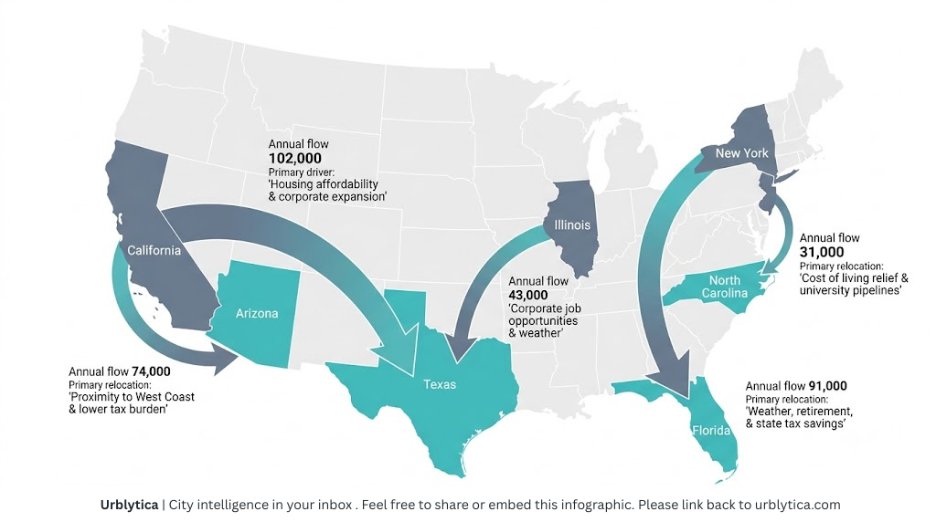
The most prominent domestic migration corridors connect coastal metropolitan areas to Sun Belt cities. California serves as the primary source of state for growth in the Intermountain West and Texas, while New York and New Jersey fuel the majority of the population influx into Florida and the Carolinas.Midsized Midwestern cities are also seeing localized growth as regional populations consolidate around stable industrial and educational hubs.
|
Source State |
Destination State |
Estimated Annual Flow |
Primary Relocation Driver |
|
California |
Texas |
102,000 |
Housing affordability, corporate relocations |
|
California |
Arizona |
74,000 |
Proximity to West Coast, lower tax burden |
|
New York |
Florida |
91,000 |
Climate preference, retirement, state tax savings |
|
Illinois |
Texas |
43,000 |
Corporate job opportunities, weather |
|
New Jersey |
North Carolina |
31,000 |
Cost of living relief, educational pipelines |
Relocating across state lines involves transmitting highly sensitive financial and personal records across multiple digital portals. To prevent identity theft and secure personal files before uploading them to leasing or purchasing platforms, individuals are advised to process their documents through a secure data sanitization tool to redact hidden metadata.
Additionally, managing the complex logistics of an interstate move requires systematic scheduling and timeline tracking. Adopting a professional deep work planner can help families organize their relocation checklists, utility hookups, and professional address updates with minimal operational disruption.
The Strain on Local Infrastructure and Public Capacities
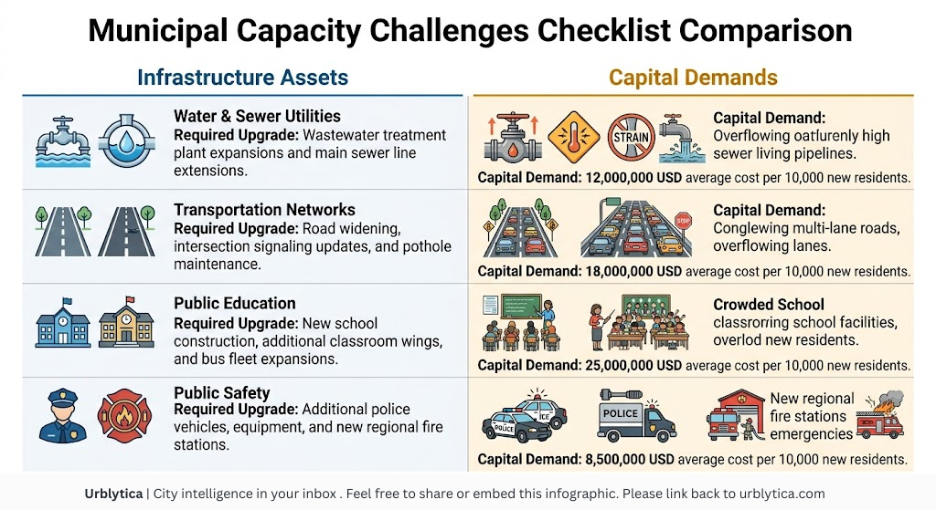
While absolute numerical growth is celebrated as a sign of economic health, it places massive, immediate demands on municipal infrastructure. Adding ten thousand to twenty thousand residents in a single year requires rapid expansion of physical utilities, public transport networks, emergency services, and local school systems. Many growing cities struggle to pace their capital improvement projects with the rate of private residential development.
Wastewater treatment plants must be upgraded, traffic lanes must be added to secondary roads, and new fire stations must be built and staffed. For school districts within highvolume counties, rapid student enrollment surges often lead to overcrowded classrooms and the immediate need to issue municipal bonds to build new educational campuses. Managing these transitions requires coordinated longterm urban planning and sustainable fiscal management.
|
Asset Category |
Required Expansion Type |
Average Cost per 10k New Residents |
Funding Mechanism |
|
Water & Sewer |
Wastewater treatment plants, main line extensions |
12,000,000 USD |
Municipal utility bonds, connection fees |
|
Roadways |
Intersection signaling, lane widening, road maintenance |
18,000,000 USD |
State transportation grants, local sales tax |
|
K-12 Education |
New classroom wings, additional school buses |
25,000,000 USD |
Public school bond initiatives, property tax |
|
Public Safety |
Additional police vehicles, regional fire stations |
8,500,000 USD |
Municipal general fund, impact fees |
Families relocating to these highvolume corridors should carefully research localized cost differences, including municipal property taxes, school bonds, and home insurance premiums. Prospective buyers can use interactive online calculators to model their postto move monthly budgets and calculate realistic home purchasing power before entering competitive housing markets.
Furthermore, transitioning households should audit their digital expenditures to free up capital for relocation costs. Running a search through a recurring expense analyzerhelpidentify and cancel redundant SaaS platform subscriptions and streaming packages before updating billing profiles to a new state.
Commercial Opportunities and Local Business Formation
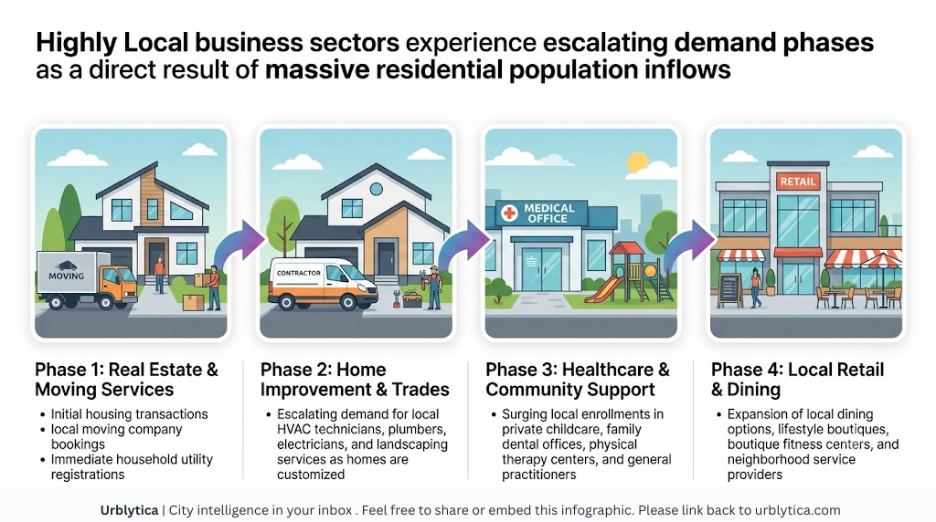
The steady influx of new residents into population growth cities creates an exceptionally fertile environment for commercial development and small business formation. New households require immediate access to service providers, home contractors, medical clinics, childcare facilities, and local dining options. Highdensity residential developments quickly transform vacant land into vibrant retail strips and lifestyle centers.
For entrepreneurs and established business owners, the key to success in a highgrowth market is early positioning. As new residential developments are completed, establishing service routes and local brand recognition can secure a permanent market share. Business owners must remain highly diligent regarding local licensing rules and statelevel compliance updates. Working with a dedicated business compliance platform helps ensure that corporate filings, annual franchise tax reports, and local permits are managed seamlessly, protecting the company from administrative penalties.
|
Sector |
Demand Index |
Initial Capital Requirement |
Registration Difficulty |
|
Home Services (HVAC/Plumbing) |
High |
Medium |
Medium (Requires state licensing) |
|
Childcare & Preschools |
High |
High |
High (Heavy state regulation) |
|
Healthcare Clinics |
High |
High |
High (Requires professional credentials) |
|
Specialty Retail & Dining |
Medium |
Medium |
Low (Standard local permits) |
As populations continue to shift from traditional megacities to highvolume secondary hubs, the cities that successfully balance physical infrastructure expansion with economic opportunity will remain the primary drivers of American prosperity. Proactive planning, smart public investments, and a supportive business environment are the keys to turning raw numerical growth into longterm, sustainable community wellness.
Frequently Asked Questions
1. What is the difference between numerical population growth and percentage growth rate?
Numerical growth measures the absolute number of people added to a population, whereas the percentage growth rate measures the change relative to the initial population size. A small city of five thousand adding five thousand residents has a hundred percent growth rate, but a large city adding fifteen thousand residents has a much larger absolute numerical impact on regional housing and infrastructure.
2. Why do Sun Belt cities dominate the list of population growth cities?
Sun Belt cities dominate due to a combination of favorable economic conditions, including lower tax burdens, a warm climate, and a lower cost of living. Additionally, these regions possess large areas of flat, buildable land surrounding major cities, allowing developers to build residential housing quickly and affordably.
3. How do major population inflows affect local home prices?
A rapid numerical influx of new residents significantly increases housing demand. If the local construction sector cannot build new housing units fast enough to match the inflow, the resulting inventory shortages lead to escalating home prices and rising rental rates in the local market.
4. What are the primary infrastructure challenges faced by numerical growth cities?
The primary challenges include immediate capacity strains on municipal water and sewer utilities, severe traffic congestion on older roadway systems, classroom overcrowding in public school districts, and the need to scale emergency services to maintain rapid response times.
5. What is a domestic migration corridor?
A domestic migration corridor is a welldefined geographic pathway along which a high volume of households relocates from one specific state or metropolitan area to another. Examples include the highvolume movement of residents from California to Texas, and from New York to Florida.
6. Why are major corporations relocating to highgrowth metropolitan areas?
Corporations are relocating to take advantage of businessfriendly tax climates, lower operating expenses, and reduced regulatory barriers. By establishing offices in regions where their employees want to live, these companies can also attract highly skilled talent at more competitive wage levels.
7. How do families calculate cost of living differences before relocating?
Relocating families must carefully evaluate differences in state income taxes, local property taxes, home insurance premiums, and municipal utility rates. Many leverage interactive financial calculators and subscription expense tracking systems to run complete monthly budget audits before moving.
8. Do population growth cities require a statelevel business license in Texas?
Texas does not require a single, general state business license to operate an LLC. However, depending on the industry and the specific municipality, business owners may need to acquire specialized professional licenses, local building permits, or a state sales tax permit to conduct commercial transactions.
9. How can local businesses capitalize on a steady influx of new residents?
Local companies can capture highintent of consumer traffic by maintainingaccurate digital footprints on local business directories and online maps. Optimizing local search engine presence allows businesses to be discovered by new arrivals who do not yet have established relationships with local service providers.
10. Where can I find official demographic data for growing American cities?
Official demographic data is compiled and released annually by the United States Census Bureau. The bureau's annual population estimates, and American Community Survey reports provide detailed data on absolute population changes, migration patterns, and household income shifts.