


Phoenix vs Las Vegas Comparison: Strategic Economic Profiles for 2026


The American Southwest has become the defining frontier of modern urban expansion, with Phoenix and Las Vegas emerging as the twin pillars of regional economic vitality. As we move through 2026, the rivalry between these two desert metropolises is not merely about size or spectacle but about distinct models of sustainable development, workforce attraction, and industrial diversification. Phoenix has leveraged its proximity to California and its massive land area to create a diversified industrial base that spans from hightech manufacturing to logistics. Las Vegas, meanwhile, has transcended its traditional reliance on tourism, evolving into a sophisticated hub for professional services, data centers, and global commerce.
For business leaders, investors, and relocating professionals, understanding the subtle differences between these two hubs is critical for longterm planning. Whether analyzing economic analysis of regional labor pools or examining the shifting patterns of domestic migration, stakeholders must look beyond surfacelevel metrics to identify which city offers the highest potential for their specific requirements.
The Demographic Landscape of the Southwest
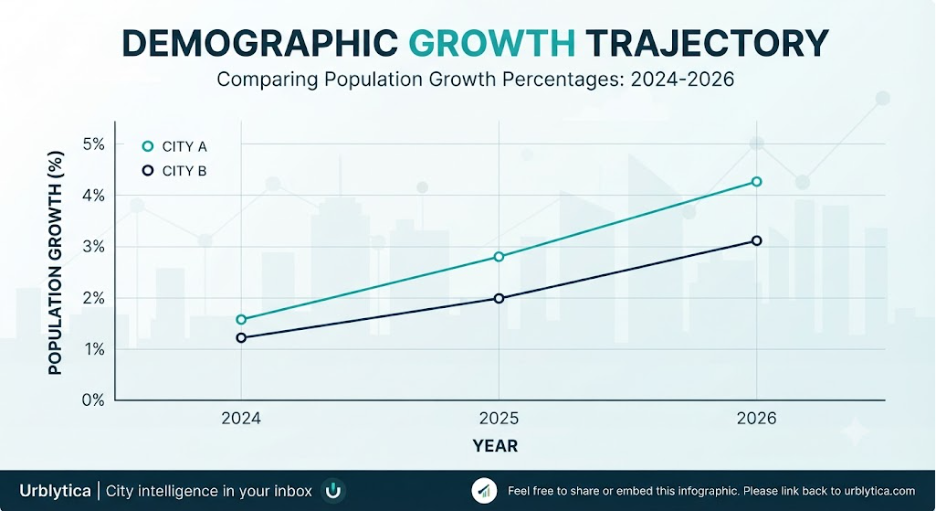
Demographics in both metropolitan areas have shifted rapidly over the past twentyfour months. The influx of new residents into Phoenix is characterized by a mix of corporate relocation and familyoriented expansion. The city attracts a wide range of skill sets, particularly in engineering and health sciences. Las Vegas, by contrast, has seen a resurgence in its professional population, as the city attracts a more diverse demographic of workers who are drawn to the combination of economic opportunity and a highenergy urban lifestyle.
Families often utilize a population growth tool to understand how these influx patterns affect local infrastructure and longterm property values. The following table provides a snapshot of the primary demographic metrics shaping these markets in 2026.
|
Demographic Metric |
Phoenix MSA |
Las Vegas MSA |
Primary Trend |
|
Annual Growth Rate |
2.1 percent |
2.3 percent |
Las Vegas leads in migration |
|
Median Age |
36.2 years |
35.5 years |
Phoenix has established households |
|
Bachelor's degree Attainment |
37 percent |
32 percent |
Phoenix shows higher education index |
|
Net Domestic Migration |
High |
High |
Both cities show strong influx |
While migration remains strong in both regions, the drivers are distinct. Phoenix benefits from its identity as a manufacturing and logistics powerhouse, while Las Vegas has become a nexus for innovation in simulation technology and hospitalitytech. Both cities are frequently cited among the best cities for business due to their taxfriendly environments and availability of land for expansion.
Economic Engines and Industrial Diversification
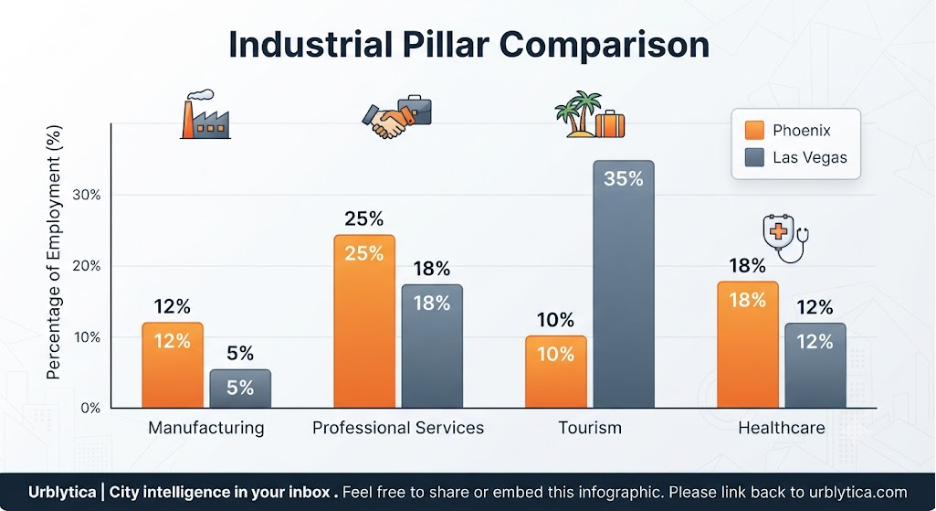
The economic bedrock of Phoenix is built on a diverse foundation of semiconductor manufacturing, financial services, and aerospace. Because of this, it is often simpler to start a business in the Phoenix area, where the regulatory environment is designed to welcome largescale corporate entities and small startups alike. The city has become a preferred destination for firms looking to move away from the high costs of the Pacific coast.
Las Vegas has undergone a significant transformation. While the gaming and tourism industry remains a pillar of the local economy, the city has aggressively diversified into areas such as health sciences, cybersecurity, and logistics. For those looking to scale an existing venture, many entrepreneurs choose to buy a business in Las Vegas that is already positioned to serve the expanding professional services sector.
|
Economic Driver |
Phoenix Share |
Las Vegas Share |
Primary Market Impact |
|
Manufacturing and Tech |
22 percent |
10 percent |
High stability in Phoenix |
|
Professional Services |
18 percent |
24 percent |
High growth in Las Vegas |
|
Hospitality and Tourism |
12 percent |
35 percent |
Las Vegas retains dominance |
|
Healthcare and Research |
16 percent |
14 percent |
High demand in both regions |
Firms that effectively manage their capital expenditure often realize that they need to maintain a strict adherence to their breakeven point to ensure that their digital and physical overhead does not erode their margins in a highgrowth environment.
Cost of Living and Housing Dynamics
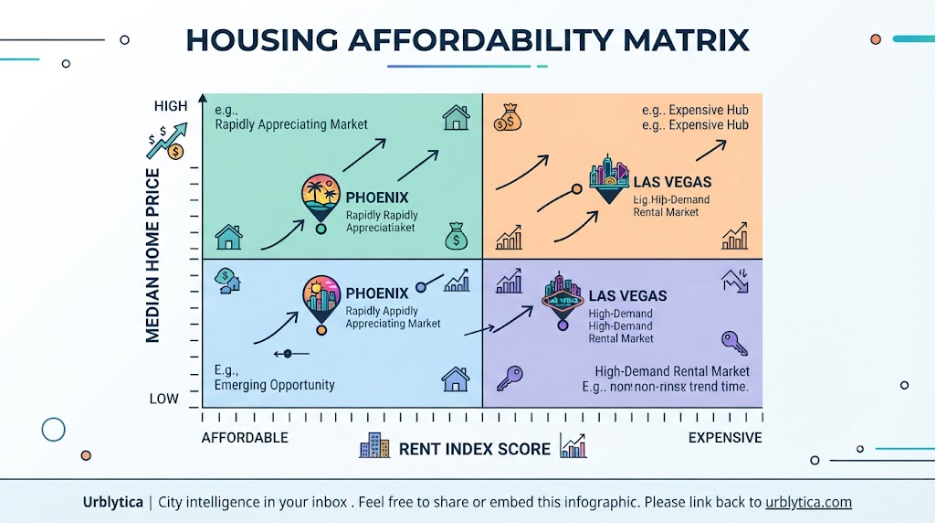
For families and individuals evaluating a move to the Southwest, the cost of living remains a central pillar of the decisionmaking process. The housing markets in both Phoenix and Las Vegas have seen sustained demand, leading to continued appreciation in home prices and rental rates. When comparing the two, many prospective residents find it useful to conduct a comprehensive cost of living assessment to determine the true value of their salary in these different tax and service environments.
The decision to transition from renting to owning is often a complex financial undertaking. Many potential residents use a rent vs buy tool to visualize their longterm financial exposure. While Phoenix offers a larger footprint of suburbanstyle living, Las Vegas provides a dense urban experience that is increasingly attractive to young professionals who prioritize proximity to work and entertainment.
|
Housing Metric |
Phoenix Market Index |
Las Vegas Market Index |
Financial Impact |
|
Median Home Price |
High |
High |
Competitive in both metros |
|
Rent Index Score |
Moderate |
High |
Las Vegas shows more density |
|
Transportation Cost |
Moderate |
Moderate |
High car dependence |
|
Utility Expense |
Moderate |
Moderate |
Consistent across Southwest |
Managing these transitions effectively involves recognizing that the financial planning for moving includes not just the purchase of property but the longterm maintenance of the household.
Entrepreneurial Environment and Incorporation
The regulatory climate in Arizona and Nevada is notoriously favorable for enterprise formation. When founders prepare to business formation in either state, they find that the procedural requirements are minimized, allowing for rapid deployment of new operations. Phoenix is often chosen by founders who need to secure large facilities for manufacturing or logistics, whereas Las Vegas is becoming a preferred spot for software and servicebased startups.
Those managing professional entities often seek out business services to handle their complex regulatory requirements. This allows founders to focus on growth rather than the minutiae of legal compliance. In both cities, the ability to maintainaccurate records and manage digital overhead is a recurring challenge. Many companies have started to audit their digital costs using a subscription analyzer to ensure their tools remain effective without ballooning in price. Founders can also incorporate online to streamline their initial registration phase.
Infrastructure and Regional Connectivity
Phoenix has made massive investments in the modernization of its highway systems to facilitate the movement of goods between Southern California and the interior of the country. For project managers, the ability to use a time blocker to navigate traffic and schedule highoutput work sessions is essential. Las Vegas has taken a similarly aggressive stance, expanded its international airport and invested in regional transit infrastructure to support its status as a global trade and conference hub.
Logistical efficiency relies on data accuracy. It is common for highvolume distribution firms to utilize an address cleanerensure that their supply chain data remains clean and errorfree. This commitment to infrastructure development is what keeps both cities ahead of the national curve in terms of economic development.
Healthcare and Senior Support Systems
The rapid aging of the American population has created a massive surge in demand for healthcare and seniorrelated services. In Phoenix, the focus has been on building massive, integrated health campuses that cater to a growing base of active retirees. In Las Vegas, the evolution of healthcare has been focused on specialty geriatric care and longterm nursing, reflecting the evolving needs of its resident base.
Families looking for highquality care often find that they need to coordinate senior care support for their relatives to ensure they have proper supervision and health management. The resources available for senior care in the Southwest are robust, but navigating these systems requires careful coordination.
|
Healthcare Metric |
Phoenix Availability |
Las Vegas Availability |
Primary Benefit |
|
Clinical Research |
Very High |
High |
Innovation in treatment |
|
Longterm Nursing |
High |
High |
Quality of care levels |
|
Assisted Living |
High |
Moderate |
Personalized lifestyle options |
|
Home Health Services |
High |
High |
Flexible care delivery |
For those who are in the process of relocating aging family members, it is highly recommended to follow a stepbystep plan for transitioning to assisted living to avoid the pitfalls of hurried decisionmaking.
Future Projections and Strategic Outlook
As we look toward the remainder of 2026 and beyond, both Phoenix and Las Vegas are expected to maintain their status as the fastestgrowing regions in the United States. Phoenix is poised to become a global leader in semiconductor and advanced manufacturing, while Las Vegas is likely to solidify its position as a diversified servicebased economy that is no longer strictly tethered to its historic reliance on gaming.
The synergy between these two cities is also increasing. As the Southwest continues to grow, firms that operate in both hubs will benefit from the shared labor pool and the strengthening of the regional trade corridor. Founders and investors should continue to track these shifts, as the geographic center of gravity for new enterprises will likely shift as infrastructure projects reach completion.
Frequently Asked Questions
1. Which city is better for starting a business, Phoenix or Las Vegas?
Phoenix is ideal for manufacturing and largescalelogistics operations, while Las Vegas offers a unique advantage for servicebased industries and professional startups that benefit from a highenergy, global market.
2. How do demographic trends differ between these two cities?
Phoenix tends to attract families and a more established professional workforce, whereas Las Vegas attracts a younger, more mobile demographic that is drawn to the diverse service and tech economy.
3. Is the cost of living significantly different in Phoenix versus Las Vegas?
Both cities have seen cost of living increases due to high demand, but Phoenix often offers a greater variety of singlefamily housing, while Las Vegas provides more options for dense, luxury urban living.
4. What industries are the primary economic drivers for each city?
Phoenix is dominated by manufacturing, aerospace, and finance. Las Vegas is driven by hospitality, professional services, simulation technology, and data center operations.
5. How do I decide which city is best for my retirement?
Both cities provide excellent medical infrastructure, but Phoenix is often preferred by those seeking more suburban comfort and outdoor recreation, while Las Vegas appeals to retirees who want to stay active in an urban, servicerich environment.
6. What legal tools are available to help with relocating a business?
Founders often utilizestatespecific portals to incorporate online, which streamlines the registration process and ensures compliance from the very first day.
7. How can businesses manage their digital overhead in these regions?
Many growing firms are now using a subscription analyzer to audit their enterprise SaaS spending and ensure that their operational costs remain lean and scalable.
8. Is the healthcare infrastructure robust in both regions?
Yes, both cities have invested heavily in geriatric care and specialized health facilities to cater to their expanding populations.
9. How does regional connectivity impact these economies?
Connectivity to major transportation hubs and the modernization of highway systems are central to the logisticsbased economy of Phoenix and the conferencedriven economy of Las Vegas.
10. Where can I find more detailed data on the economic performance of these cities?
You can explore comprehensive regional market viability data to get an indepth look at growth statistics, population metrics, and industrial performance in the Southwest.